


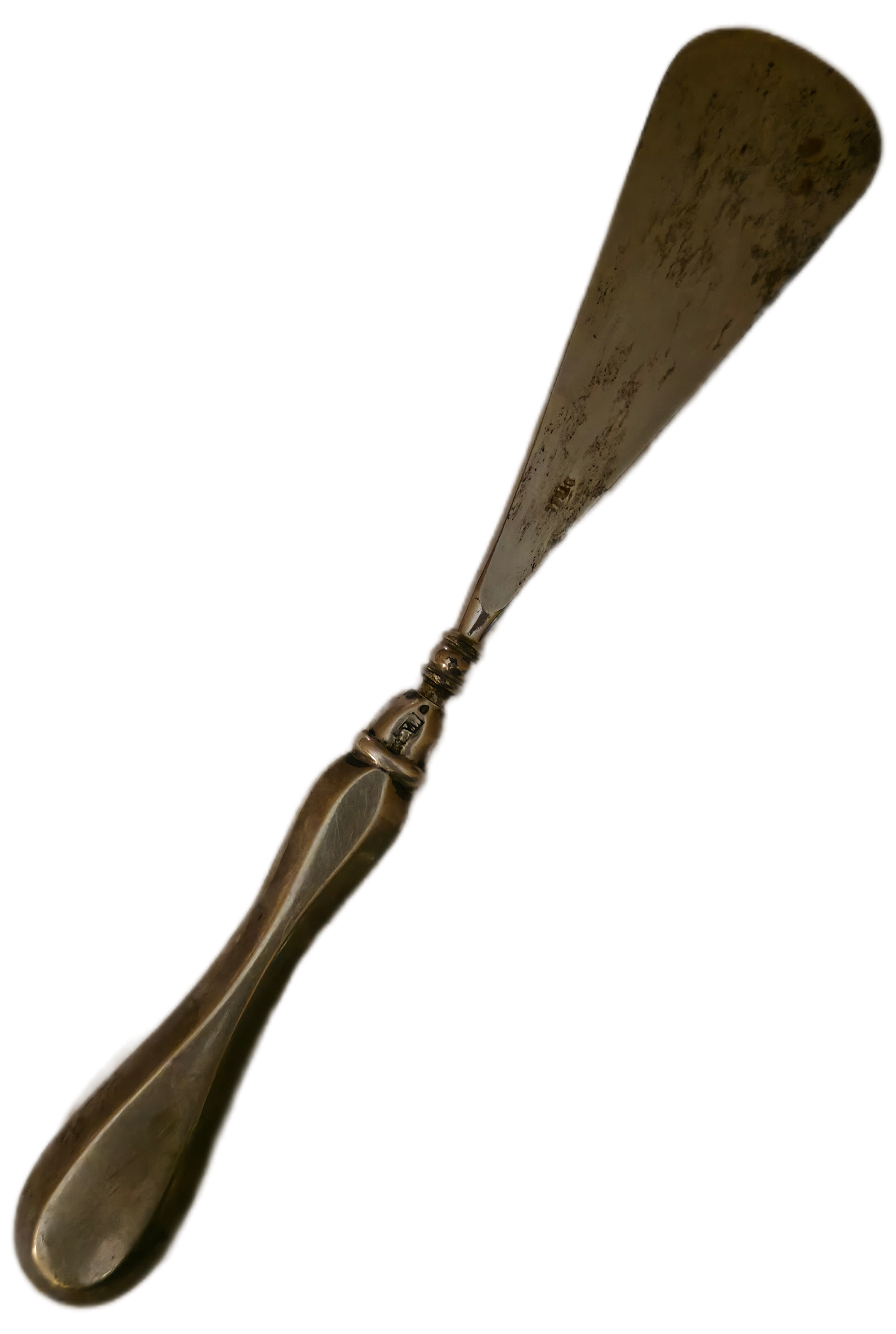

Silver Shoe Horn of Gustav Krupp
Silver Shoe Horn of Gustav Krupp
This silver shoe horn, acquired and personally used by Gustav Krupp in the 1930s, reflects the discreet refinement of a man whose influence shaped the industrial destiny of Europe. Commissioned as a private luxury item, it exemplifies the quiet authority and utilitarian elegance that defined Krupp’s personal world.
Gustav Krupp, patriarch of the Krupp dynasty and architect of Germany’s steel empire, surrounded himself with objects that mirrored his discipline and stature. This shoe horn, preserved in its original state and untouched by restoration, was part of his personal effects—an intimate tool in the daily rituals of a life governed by precision. Its surface, smooth and gently curved, bears the subtle traces of use—fine abrasions and a soft patina that speak to its age and authenticity.
Accompanied by documentation confirming its provenance, the piece offers collectors a rare opportunity to engage directly with the material legacy of one of the 20th century’s most consequential industrialists. It is a relic of power rendered in silver, where form and function converge in quiet dignity.
Gustav Krupp von Bohlen und Halbach was the silent architect of Germany's war industry—a man who turned iron into power and profit into ideology. Behind the austere face of a diplomat lay the strategic mind that armed Germany for two world wars.
Born in 1870 in The Hague, the son of a diplomat, Gustav studied law and served in embassies in Washington, Beijing, and the Vatican. But his destiny changed radically in 1906 when he married Bertha Krupp, heiress to Europe's most powerful steel empire. With the blessing of Emperor Wilhelm Il, he adopted the Krupp name and, in 1909, became president of Friedrich Krupp AG, transforming it into an industrial machine devoted to war.
Under his leadership, Krupp became the beating heart of German armament: cannons, tanks, steel for fleets and trenches. Gustav was not just an industrialist-he was an ideologue of military efficiency, a man who believed in the fusion of enterprise and nation. In 1931, he became president of the Reich Federation of German Industry, openly supporting the Nazi regime and fueling its economic rise.
But his power cast long shadows. During the Third Reich, Krupp factories employed forced laborers, including prisoners of war and deportees, under brutal conditions.
Gustav, by then elderly and ill, was listed among the main defendants at the Nuremberg Trials, but his health spared him from prosecution. He died in 1950 in Austria, leaving his son Alfried the burden of an empire stained with iron and blood.
Today, Gustav Krupp is studied as a symbol of collusion between industry and totalitarianism, between profit and destruction. He was never a general, but his factories were battlefields. His name may not appear in strategy manuals, but every shell bearing the Krupp mark tells the story of a man who made war his business.
Doktor Lazarus Archaeologist, Historian, Collector, Independent Curator
